Using Data Analytics Services to Align Teams With Business Goals
Using data analytics services to align teams with business goals has become a necessity for organizations operating across the US and Canada. Growth brings complexity, and complexity often creates misalignment. Sales focuses on closing deals, marketing optimizes campaigns, operations chase efficiency, and finance controls costs. Each team performs well individually, yet the organization struggles to move in one clear direction.
Data exists to solve this problem, however raw data alone does not create alignment. When analytics is fragmented, teams interpret numbers differently. As a result, meetings turn into debates instead of decisions. Over time, trust in data declines, and strategic goals lose their meaning at the execution level.
Why Team Misalignment Happens as Companies Scale
Using data analytics services to align teams with business goals starts by understanding why misalignment happens in the first place. In many US and Canadian organizations, teams grow faster than processes. New tools are added, new KPIs appear, and reporting becomes inconsistent.
Moreover, each department often defines success differently. Marketing celebrates engagement, sales focuses on pipeline value, while operations track efficiency. Although these metrics matter, they rarely connect to shared business outcomes. Consequently, teams optimize locally while the organization underperforms globally.
Another common issue is delayed or incomplete reporting. When teams rely on outdated dashboards or manual reports, decisions lag behind reality. Eventually, teams stop using data proactively and rely on intuition instead.
How Data Analytics Services Create Alignment Across Teams
Using data analytics services to align teams with business goals changes how organizations operate day to day. Instead of isolated metrics, analytics services focus on shared objectives that matter across departments. Revenue growth, customer retention, and operational efficiency become common reference points.
For example, in a North American SaaS company, analytics can connect marketing campaigns directly to qualified pipeline and closed revenue. Sales teams see which leads convert best, while marketing understands which channels drive real growth. At the same time, leadership gains a unified view of performance.
Additionally, analytics services standardize definitions. When everyone agrees on what a metric means, conversations become more productive. Teams spend less time arguing about numbers and more time acting on insights.
Aligning Strategy and Execution With Shared Metrics
Using data analytics services to align teams with business goals also bridges the gap between strategy and execution. Leadership sets targets, yet teams need clear indicators to understand how their daily work contributes to those goals.
Analytics services translate high-level objectives into measurable outcomes. For instance, a goal to improve customer experience can be linked to retention rates, support response times, and lifetime value. As a result, teams see exactly how their actions influence business performance.
In US and Canadian organizations with distributed teams, this clarity becomes even more important. Consistent reporting ensures that everyone operates with the same priorities, regardless of location or function.
Reducing Conflicting Priorities Through Unified Dashboards
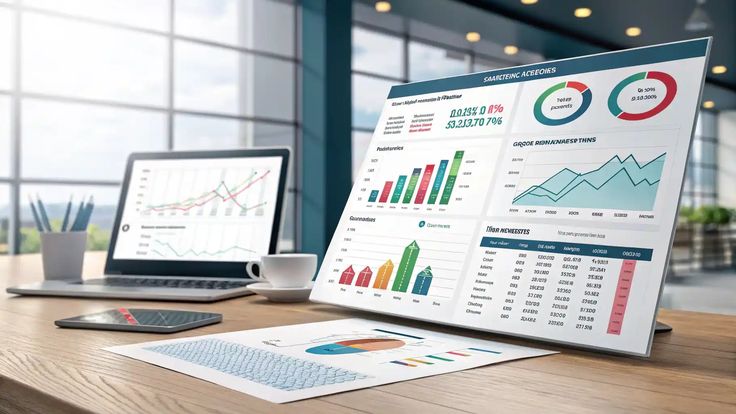
Using data analytics services to align teams with business goals often involves replacing multiple reports with unified dashboards. Instead of separate views for each department, leaders and teams access shared performance views.
These dashboards highlight trade-offs clearly. For example, aggressive discounting may increase short-term sales but reduce profitability. When teams see these relationships in real time, they collaborate instead of competing.
Furthermore, unified dashboards improve accountability. Teams understand how their performance impacts others. Over time, this transparency builds trust and encourages cross-functional collaboration.
Real Business Impact for US and Canadian Organizations
Using data analytics services to align teams with business goals delivers measurable impact for organizations across the US and Canada. Faster decisions reduce missed opportunities. Clear priorities improve execution. Consistent metrics support sustainable growth.
Mid-sized companies benefit by scaling without chaos. Enterprise organizations benefit by breaking down silos. In both cases, analytics becomes a shared language rather than a reporting burden.
Importantly, alignment improves employee confidence. When teams understand goals and see progress clearly, engagement increases and friction decreases.
Common Mistakes That Prevent Alignment
Another mistake appears when analytics insights are not embedded into workflows. Reports reviewed once a month rarely influence daily decisions. Successful organizations integrate analytics into planning, reviews, and execution cycles.
Finally, leadership behavior matters. If executives ignore data when making decisions, teams will do the same. Alignment starts at the top and spreads through consistent usage.
Frequently Asked Questions (Q&A)
How do data analytics services improve team alignment?
They create shared metrics, consistent definitions, and unified reporting that connects daily work to business goals.
Which teams benefit most from aligned analytics?
Sales, marketing, operations, and finance all benefit when performance metrics are connected and visible across the organization.
Is this approach suitable for mid-sized companies in the US and Canada?
Yes. Mid-sized organizations often see faster results because fewer systems need to be aligned.
How quickly can teams see alignment improvements?
Many organizations notice clearer priorities and faster decisions within the first few months.
Moving Teams Forward With Clarity
Using data analytics services to align teams with business goals transforms data into a unifying force. Instead of pulling in different directions, teams move together with clarity and confidence.
Pingback: How External Analytics Experts Support Strategic Planning - omartheanalys